

State-Calibrated Breathwork: Meeting Your Physiology Where It Lives
State-Calibrated Breathwork: Meeting Your Physiology Where It Lives
Mainstream breathwork trends often operate on rigid, unyielding rules: "breathe in for 4, hold for 7, exhale for 8," or execute hyperventilatory sequences to force catharsis. But when a human nervous system is locked in acute anxiety, a panic attack, or deep sympathetic arousal, imposing arbitrary counts or forcing deep, artificial breaths can backfire dramatically. Forcing intense respiratory demands onto a dysregulated body frequently spikes air hunger, heightens perceived threat, and drives the nervous system deeper into survival mode.
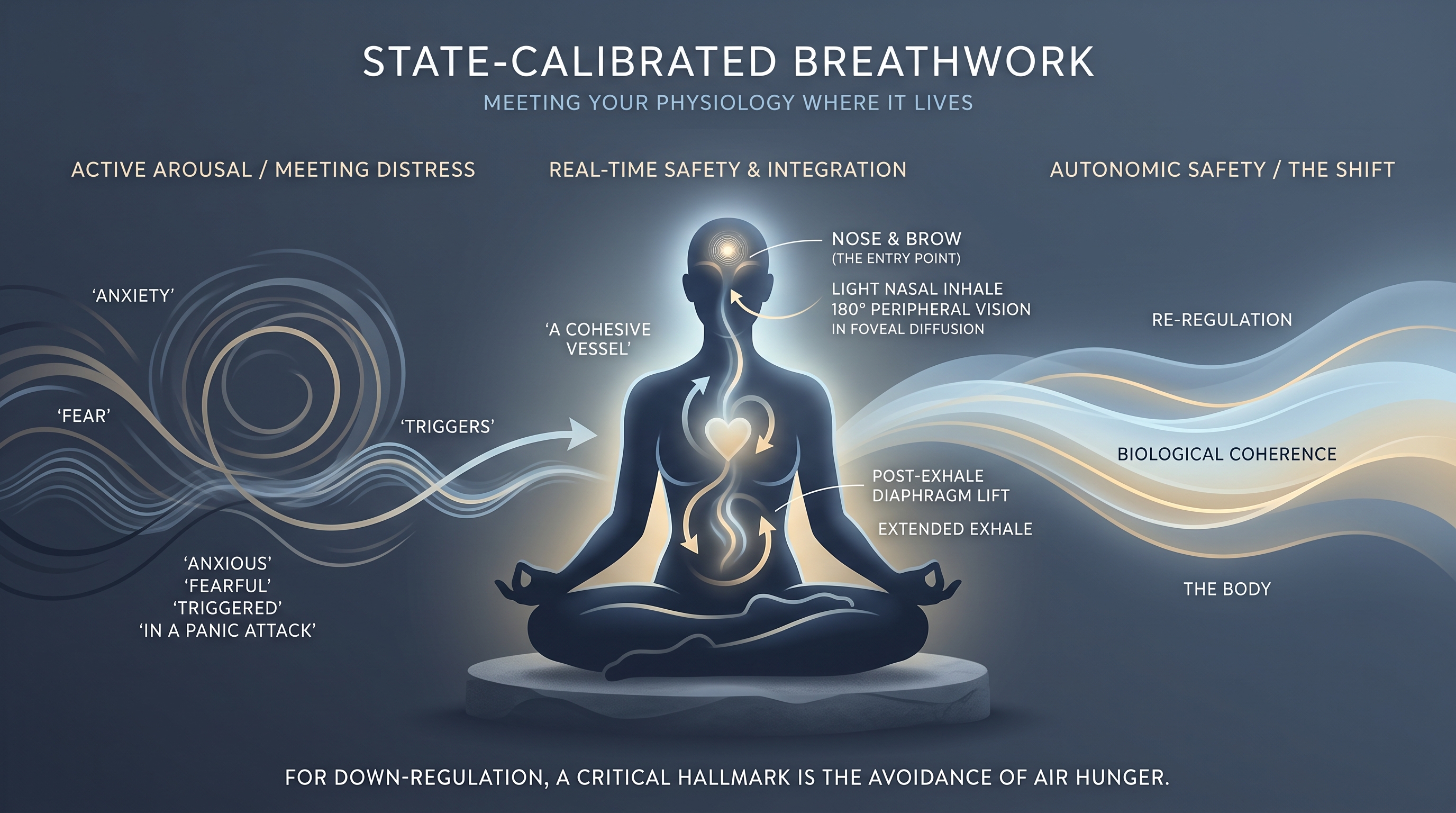
The Mind-Body-Breath (MBB) methodology replaces rigid protocols with State-Calibrated Breathwork. Rather than forcing your body into a preset box, state calibration means adjusting respiratory parameters—volume, cadence, ocular focus, and somatic engagement—to match your current baseline, physiological tolerance, and immediate state of arousal.
The Golden Rule: Avoidance of Air Hunger During Down-Regulation
For down-regulation, a critical hallmark of MBB state-calibrated breathwork is the avoidance of air hunger. When the brainstem senses carbon dioxide imbalance or restricted air supply beyond its current tolerance, it triggers an instinctual suffocation alarm—instantly elevating heart rate, vasoconstriction, and sympathetic arousal.
Meeting your physiology where it is means honoring your body's real-time bandwidth. If you are in acute distress, you may not be capable of reducing your intake volume by more than 5%, nor can you extend your exhale without inducing panic. In that moment, forcing an extended exhale is counterproductive. Instead, you begin with whatever micro-entry point your body allows—perhaps nothing more than blurring your visual focus or executing a subtle diaphragm lift—and layer in further cues only as nervous system capacity expands.
The Layered 3-Breath MBB Progression
Rather than demanding a full protocol immediately during an adrenaline surge, MBB employs a progressive, state-matched layering model:
Step 1: The Initial Entry Point (Ocular & Visceral Anchors)
When panic or high-conflict tension strikes, start only with what is available without resistance:
- Foveal Diffusion (180° Peripheral Vision): Soften your visual focus. Instead of remaining locked in narrow, threat-focused vision (foveal lock), intentionally broaden your visual field horizontally to encompass far peripheral space. This ocular-afferent input signals safety directly to the brainstem without requiring any change to your breath.
- Subtle Diaphragm Engagement: If breathing feels restricted or rapid, initiate a gentle post-exhale diaphragm lift (softly drawing the abdominal wall inward at the end of a natural breath) to jumpstart a frozen or hyper-tonic diaphragm without causing gasping.
Step 2: Layering Respiratory Parameters (As Bandwidth Re-opens)
As the initial ocular and visceral anchors down-regulate acute brainstem alarm, layer in state-calibrated respiratory adjustments as your physiology tolerates them:
- Sub-Maximal Nasal Inhale: Softly reduce inhale volume by 5% to 30% through the nose. Keeping the inhale light prevents acute hyperventilation, protects blood carbon dioxide balance, and maintains optimal cerebral blood flow.
- Extended Nasal Exhale: Gradually lengthen the nasal exhale past the duration of the inhale. Extending the exhalation phase stimulates vagal afferent pathways, lowering heart rate and smoothing autonomic tone—strictly within the bounds of comfort.
- Post-Exhale Diaphragm Lift (Full Integration): At the quiet bottom of the extended exhale, hold the brief pause and lift the diaphragm to reset visceral tone and restore full respiratory flexibility—completely free of air hunger.
Somatic Sovereignty: Calibration over Compliance
True self-regulation is not about compliance to a rigid external counting sequence; it is an active, responsive dialogue with your internal environment. By honoring your baseline tolerance and calibrating every cue to your immediate state, you transform breathwork from an uncomfortable struggle into a precise, sovereign mechanism for real-time safety and lasting resilience.
To explore clinical state-calibration protocols and advanced MBB training, visit www.Mind-Body-Breath.com.