

State-Calibrated Breath: How to Read Your Nervous System and Shift Your State One Step at a Time
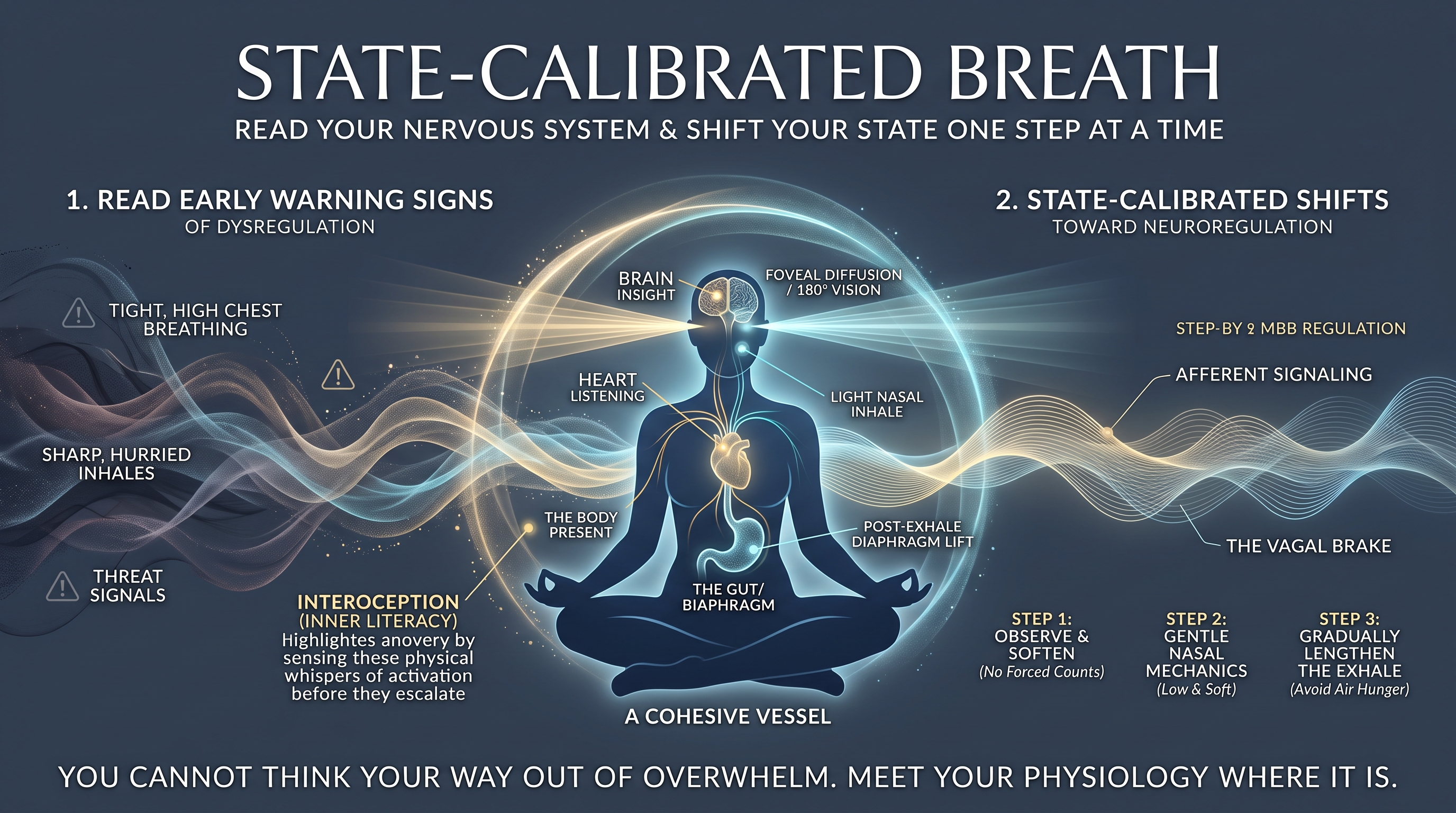
State-Calibrated Breath: How to Read Your Nervous System and Shift Your State One Step at a Time
Most people treat breathwork like a fire extinguisher—something you grab only after an emotional blaze is already out of control. Yet your breath is far more than an emergency brake. Long before stress turns into full-blown anxiety, panic, or shutdown, your breathing pattern shifts in subtle, measurable ways.
When you learn to read those shifts in real time, your breath becomes both a diagnostic gauge and your most reliable lever for self-regulation.
Interoception: Recognizing Safety and Threat in the Body
As you develop interoception—your brain’s ability to sense and interpret internal bodily signals—you become attuned to subtle shifts beneath the surface of your thoughts. You begin to recognize, physically and unmistakably, where you feel grounded and safe versus where your system is registering threat.
That internal literacy creates an immediate sense of stability. Instead of being blindsided by sudden overwhelm, you can feel the early physical whispers of activation while they are still small and manageable.
The Grounding Power of Afferent Signaling
Through Mind-Body-Breath programs, you learn to work with the grounding power of afferent signaling—the continuous stream of sensory information traveling from your body up to your brainstem.
Respiration sits at a unique crossroads in human physiology: it is the only autonomic mechanism you can both observe passively and direct consciously. Because of that direct pathway, your breath acts as a real-time indicator of your current nervous system state—and a powerful predictor of where you are headed next.
Reading the Early Warning Signs of Dysregulation
When your nervous system begins tilting toward fight-or-flight, your respiratory mechanics change before your conscious mind even names the emotion. You might notice:
- Your breath speeding up and migrating high into the upper chest
- Your inhalations becoming sharp, dominant, and hurried
- An urge to take larger, open-mouth breaths
Left unchecked, those mechanics feed threat signals straight back to the brainstem, reinforcing the very stress response you want to avoid. Catching them early tells you that you are on the path toward stress, anxiety, and dysregulation—giving you a critical window to intervene.
Why Simply Watching the Breath Begins the Shift
Your first step isn't forcing a dramatic breathing pattern. It is simply bringing informed, non-judgmental attention to what your breath is already doing.
In physiology, observation changes the system. Simply watching your breath naturally slows and softens its rhythm. As your respiratory pace settles, your nervous system begins ratcheting down its production of stress chemicals—lowering circulating cortisol, adrenaline, and norepinephrine. Watching your breath with a clear understanding of what your body is communicating moves you out of passive reaction and puts you back in the driver’s seat.
Why Jumping Straight to Box Breathing Can Backfire
Once you recognize that you are dysregulated, having state-matched tools to recalibrate empowers you into genuine regulation. Breath is your first line of action—but sequence matters.
When you are already inhale-dominant, chest-breathing, and riding a wave of sympathetic arousal, jumping straight into a rigid technique like box breathing is often too much, too soon. Forcing equal-count breath holds when your system is primed for threat can trigger a sense of air hunger, pushing your nervous system further into alarm rather than calm.
Instead, state-calibrated breathing meets your physiology exactly where it is:
- Observe and soften: Acknowledge the current breath without forcing a sudden change.
- Shift to gentle nasal mechanics: Reduce air volume slightly and let the breath settle lower into the body.
- Lengthen the exhale gradually: Allow the exhalation to smooth out and extend comfortably, engaging your vagal brake without strain.
Taking one appropriate, physiologically matched step at a time guides your nervous system back into regulation—and gives you the stability to stay there.
Ready to learn how to read your body’s signals and build a breath protocol calibrated to your physiology?
Explore individualized programs and neuro-respiratory training at www.Mind-Body-Breath.com.