

Reprocessing vs. Recalibration: EMDR and the Afferent Advantage of Foveal Diffusion
Reprocessing vs. Recalibration: EMDR and the Afferent Advantage of Foveal Diffusion
For decades, Eye Movement Desensitization and Reprocessing (EMDR) has served as a cornerstone of trauma therapy. By utilizing bilateral stimulation—typically moving the eyes side-to-side across the visual midline—EMDR helps the brain reprocess stuck traumatic memories. Yet many individuals who undergo EMDR or similar eye-tracking protocols discover a significant limitation: while the memory itself may become less emotionally charged over time, the body’s real-time threat response can still trigger when daily stress strikes.
The Mind-Body-Breath (MBB) methodology takes a fundamentally different approach. Rather than focusing on memory reprocessing through forced ocular tracking, MBB utilizes Foveal Diffusion—a precise ocular-afferent technique designed to down-regulate the nervous system in real time by restoring panoramic visual awareness.
The Visual Difference: Bilateral Eye Tracking vs. Panoramic Diffusion
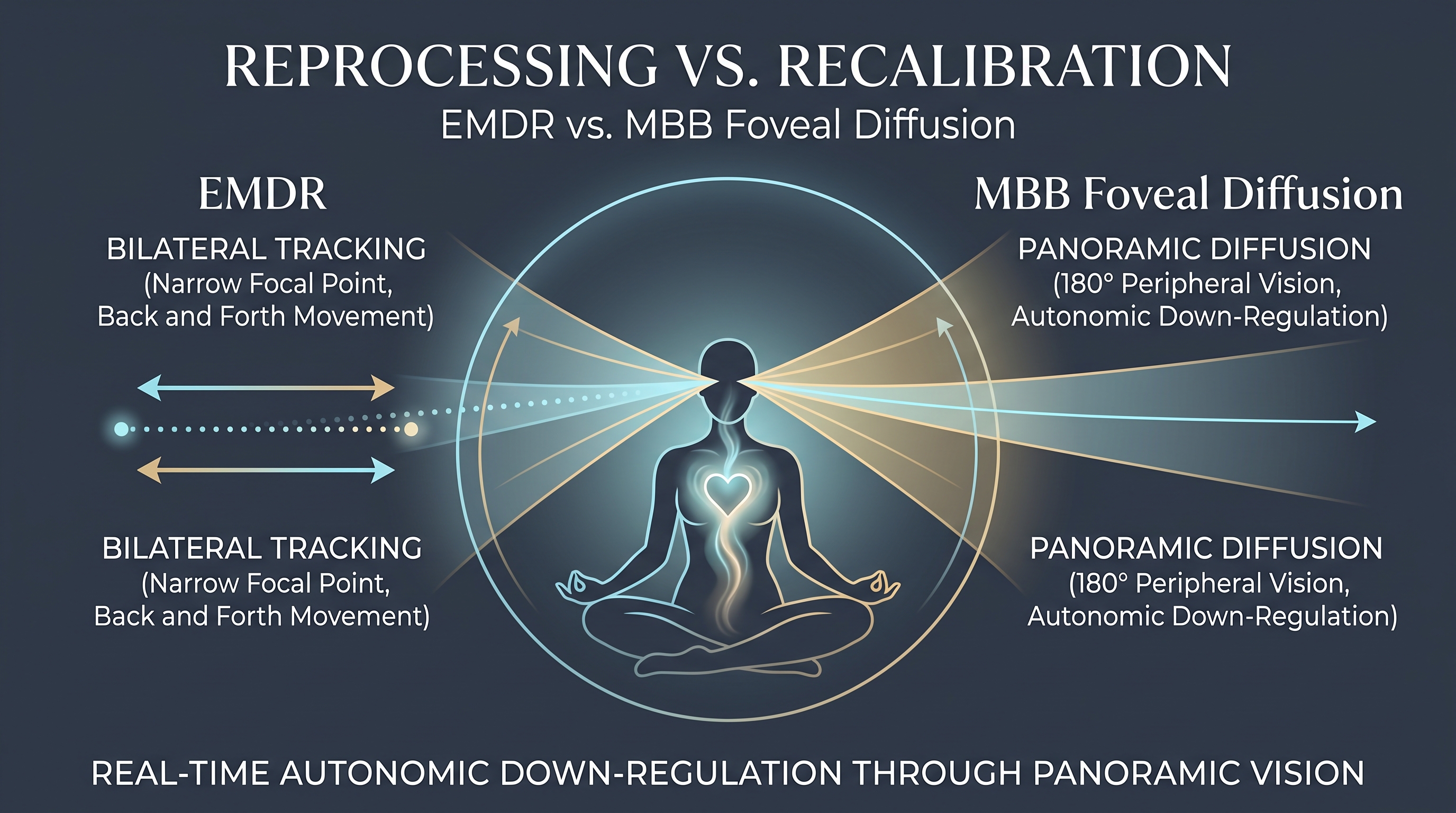
Understanding why Foveal Diffusion and EMDR produce distinct autonomic outcomes requires looking at the ocular mechanics involved:
- EMDR (Ocular Tracking & Reprocessing): EMDR relies on active, tracking movements across the central visual field. While this bilateral tracking engages working memory to uncouple traumatic associations from cognitive loops, keeping the eyes focused on a moving focal target maintains high central visual demand. For a nervous system trapped in severe hyperarousal, active ocular tracking can sometimes feel disorienting or overwhelming.
- MBB (Foveal Diffusion & Autonomic Shift): Foveal Diffusion interrupts "foveal lock"—the narrow, hard-focus visual mode that automatically accompanies sympathetic survival activation. Instead of moving the eyes back and forth, you soften your central gaze and broaden your visual field horizontally to include far peripheral space. This panoramic expansion directly signals safety to the brainstem via ocular afferent pathways, immediately suppressing the Default Mode Network (DMN) and interrupting acute threat loops.
The Multi-Modal Integration: Why Single-Input Modalities Fall Short
EMDR operates primarily as a singular visual/sensory input. However, because a survival-organized nervous system activates across multiple physiological channels simultaneously—visual focus, muscular tension, and respiratory volume—isolated visual tracking often leaves somatic constrictions intact.
The MBB protocol stands apart by integrating Foveal Diffusion into an synchronized, multi-modal intervention that meets your exact autonomic baseline:
1. Visual Afferent Modulation (Foveal Diffusion)
By shifting from narrow foveal focus to broad peripheral awareness, you disarm the brain's visual threat-detection centers while keeping your eyes open, grounded, and present in your immediate surroundings.
2. State-Calibrated Respiratory Tuning
Rather than prescribing generic, deep breaths that can induce air hunger or panic, MBB deploys state-calibrated breathwork. In hyperarousal, inhales are reduced by 30% to 50% in volume to prevent hyperventilation and cerebral vasoconstriction, while exhales are extended with soft humming or Ujjayi backpressure to stimulate vagal tone.
3. Visceral Diaphragm Engagement & Lift
During the extended exhale, MBB engages a targeted diaphragmatic lift (drawing the abdominal wall inward to jumpstart a rigid or hyper-tonic diaphragm). Holding this lifted diaphragm at the end of the exhale resets visceral tone and re-establishes respiratory flexibility without triggering air hunger on the subsequent light inhale.
4. Somatic Anchor Integration
Simultaneously softening the extraocular muscles behind the eyes relaxes micro-tensions in the suboccipital region, jaw, and upper trapezius, uncoupling physical bracing patterns at their origin.
From Clinical Therapy to Real-Time Sovereignty
While EMDR remains a valuable clinical tool for memory processing within structured therapy sessions, it is rarely something you can execute seamlessly while leading a meeting, sitting in heavy traffic, or navigating a high-stakes personal interaction.
The MBB framework equips you with portable, bottom-up regulation tools that require no external apparatus, quiet rooms, or facilitators. By combining ocular afferents, diaphragmatic mechanics, and state-calibrated breathing into a single, cohesive intervention, you don't just reprocess past events—you master your real-time physiological baseline in the exact moments life happens.
To explore clinical protocols and training in the Mind-Body-Breath system, visit www.Mind-Body-Breath.com.