

The Afferent Advantage: How Foveal Diffusion Rewires the Mind-Body-Breath Framework
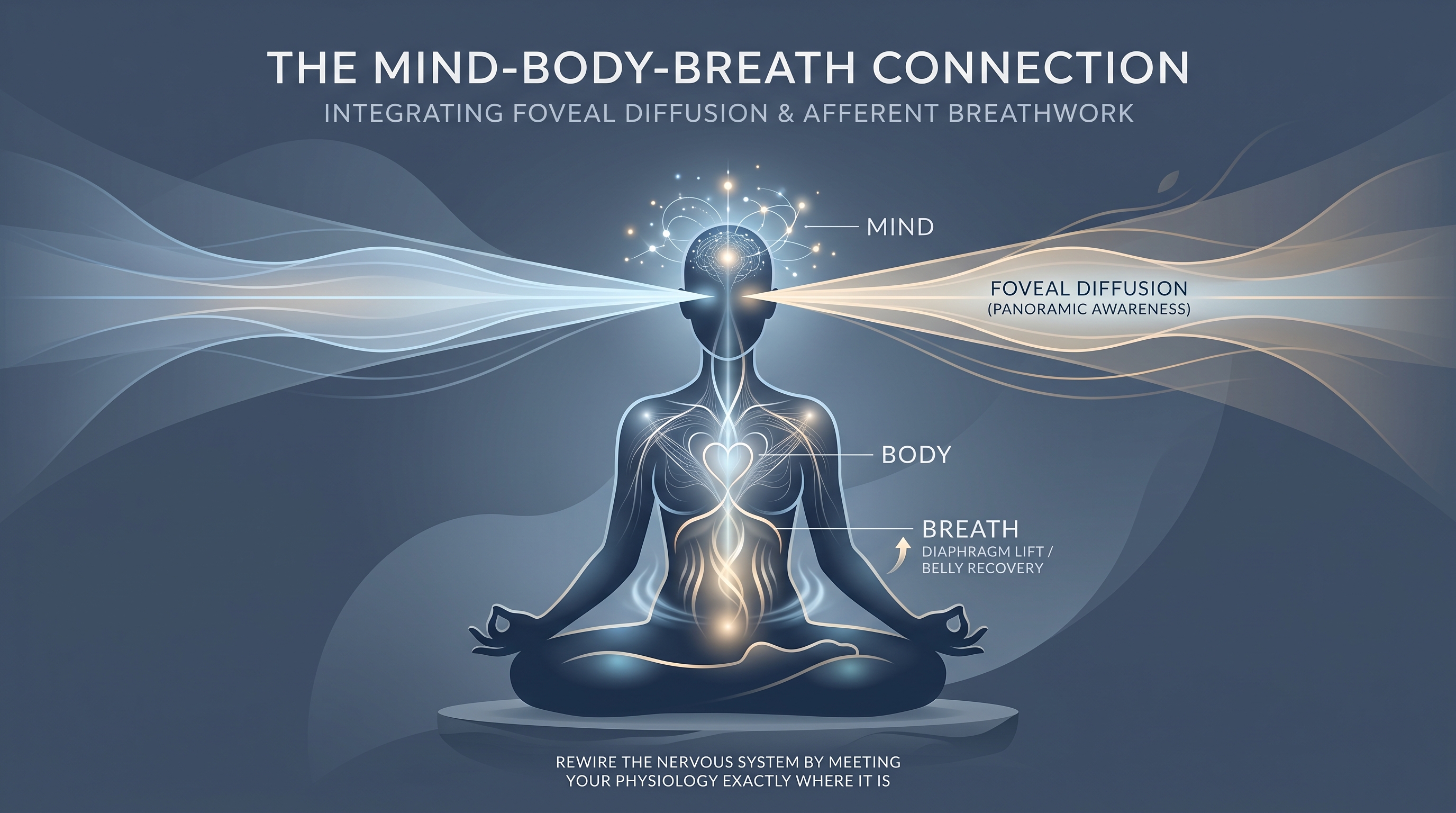
Most breathwork practices attempt to change the mind from the top down—using conscious thought or rigid counting to force an altered state of consciousness. However, the nervous system rarely responds to visual or mental force when it is organized around survival.
To create a genuine biological shift, the Mind-Body-Breath (MBB) framework integrates Foveal Diffusion directly into its methodology, leveraging afferent pathways—the bottom-up signaling streams that convey information from the periphery (the body and eyes) directly to the central nervous system. By weaving this specialized visual orientation technique into MBB's unique breathwork, we unlock a direct, physiological doorway to nervous system regulation that works with your biology rather than against it.
What is Foveal Diffusion?
Your visual field operates through two primary modes:
- Foveal Vision (Focal): Sharp, narrow, high-resolution central focus. This vision style is heavily tied to sympathetic activation (the fight-or-flight response). When you are stressed, your pupils dilate, and your field of vision narrows to scan for specific threats or tasks.
- Peripheral Vision (Diffuse): Wide, soft, panoramic awareness. Expanding your visual awareness to include the far left and right edges of your environment signals safety to the brain, activating the ventral vagal circuit and down-regulating the autonomic nervous system.
Foveal Diffusion is the intentional transition from rigid visual fixation to panoramic peripheral awareness. When paired with state-matched breathwork within the MBB framework, it acts as a physiological circuit breaker for hyperarousal and a gentle anchor for hypoarousal.
The Afferent Advantage in the MBB Framework
Afferent signals make up nearly 80% of the vagus nerve's fibers—meaning the body sends far more information up to the brain than the brain sends down to the body. Foveal Diffusion acts as a visual afferent trigger, while MBB provides the somatic and respiratory structure.
1. Mind: Orientation and Visual Loop Interruption
Before altering your breathing pattern, observe your visual focus. In hyperarousal, the eyes are often hyper-focused, darting, or fixated on a singular point or screen (foveal lock). In hypoarousal, the eyes may be unfocused, heavy, or staring blankly into space (a dissociative stare).
The Integration: Instead of demanding mental stillness, gently invite your visual field to expand horizontally. Notice the space to your far left and far right without moving your eyeballs. This single afferent input interrupts the cognitive panic loop by proving to the brainstem that no immediate physical threat exists in your environment.
2. Body: Releasing the Somatic Blueprint
Visual strain directly affects the muscles of the neck, jaw, and suboccipital region. High-stress states cause micro-tension around the extraocular muscles and facial fascia, while softening the gaze naturally encourages a release in the upper trapezius, jaw line, and suboccipital space.
The Integration: As you maintain soft peripheral vision, scan the physical body for resonance. Allow the muscles behind the eyes to soften back into the eye sockets. This physical softening creates space for the diaphragm to contract and expand without somatic constriction.
3. Breath: Precision State-Matched Tuning
Once the visual and somatic afferent pathways are open, state-matched breathwork acts as a precision tuning fork:
For Hyperarousal (Sympathetic Overdrive), broad Foveal Diffusion combined with volume-reduced inhales, extended exhales, and backpressure reduces sympathetic tone. This allows the controlled exhale and diaphragmatic lift to stimulate the vagus nerve without triggering air hunger or claustrophobia.
For Hypoarousal (Dorsal Vagal / Freeze State), bringing visual awareness inward with the breath connects visually with somatic engagement. Linking visual awareness directly to the strong diaphragm lift brings tone and energy back into the nervous system without causing an autonomic spike.
Why Top-Down Directives Fail (and Why This Works)
Standard breathwork often asks individuals to "close your eyes and take a deep breath." For an activated nervous system, closing the eyes removes vital environmental safety cues, forcing the brain into hyper-vigilance.
Combining Foveal Diffusion with MBB Afferent Breathwork honors your body's survival instincts:
- Keeps the Eyes Open & Safe: Visual diffusion allows you to remain grounded in your physical environment.
- Utilizes Dual-Pathway Regulation: Combines ocular afferents (eyes) and vagal afferents (diaphragm/viscera) to signal brainstem safety.
- Respects Individual Baseline: Adapts the breathing pattern directly to the real-time state of your nervous system.
Practicing the Integration: A Quick Start Guide
- Find a Fixed Point: Look straight ahead at an object in front of you.
- Expand the Field: Without moving your eyes, broaden your attention to notice the walls, room edges, or ceiling on the periphery of your vision.
- Scan the Body: Feel the tension in your jaw and neck melt as your visual field widens.
- Apply the Breath:
- If feeling anxious/overwhelmed: Inhale softly for what feels like 30% to 50% less volume than what you normally inhale, then exhale smoothly with a hum for 20% to 50% longer than your inhale. As you exhale, lift your diaphragm (or draw in your abdominal wall to jumpstart a tight diaphragm). Hold the lifted diaphragm as long as comfortable without gasping on the return breath. Ensure your subsequent inhale remains another light, unforced breath.
- If feeling numb/sluggish: Apply the exact breathwork outlined above, but bring your visual awareness in with the breath and connect visually with the strong diaphragm lift.
By meeting your physiology where it is—using visual and respiratory afferent inputs—you stop fighting your nervous system and start guiding it home. Visit www.Mind-Body-Breath.com to explore clinical protocols and training.